Coffee Cart Business Plan Template
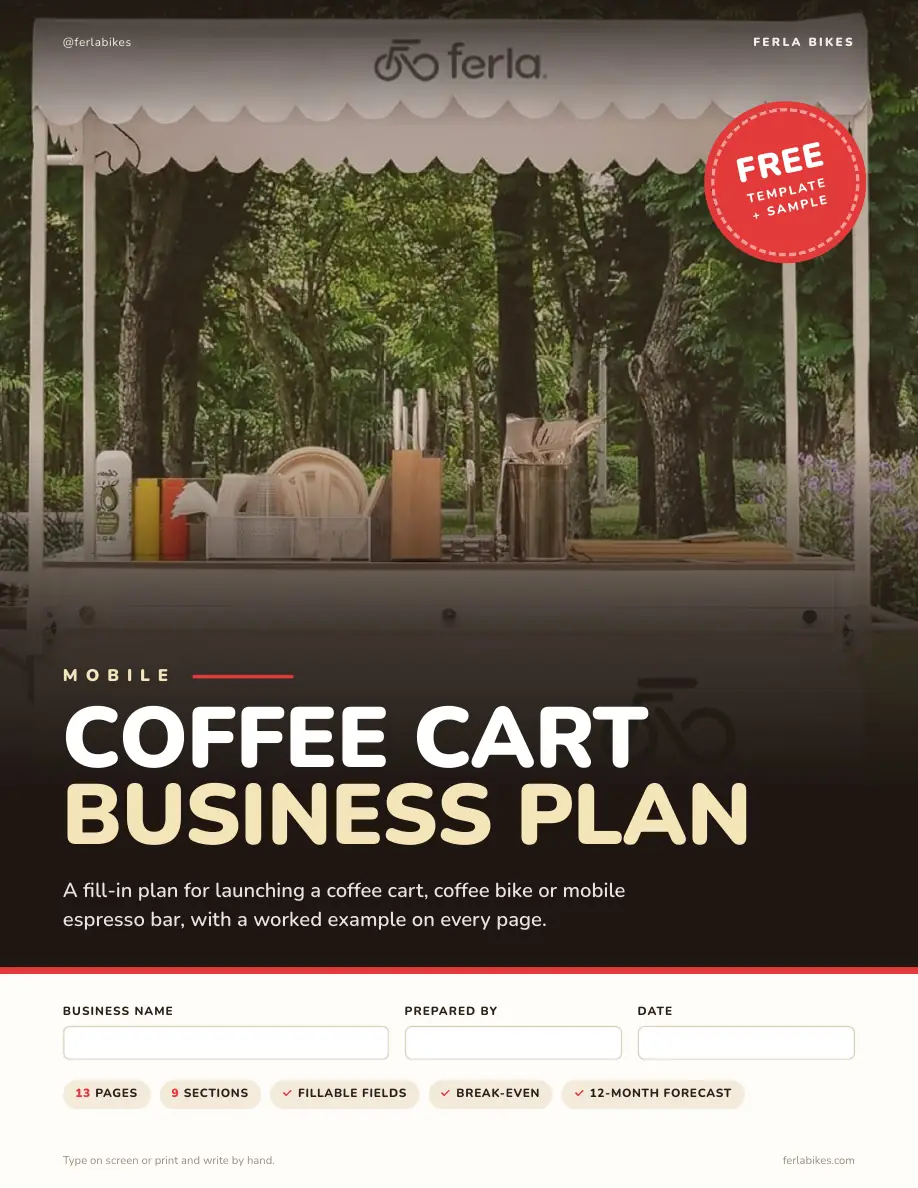
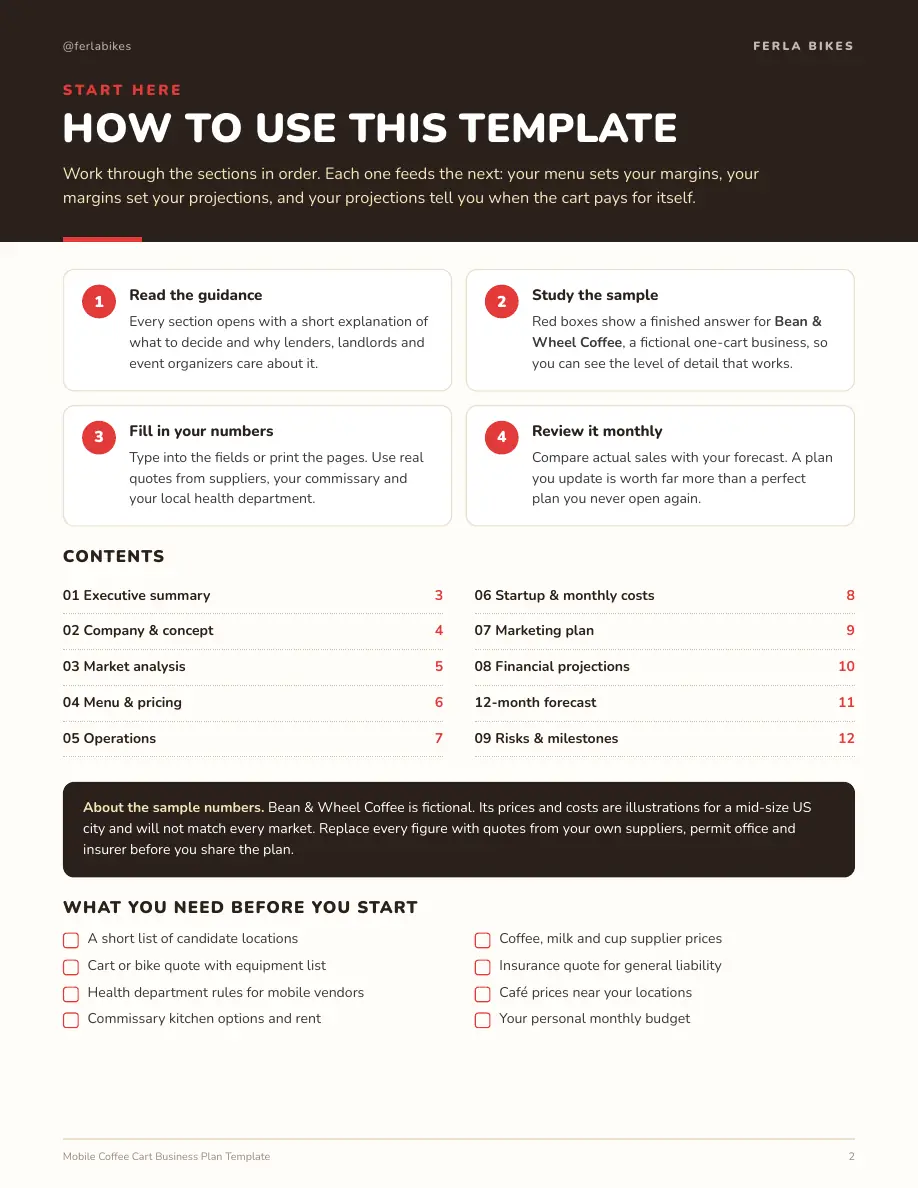
Scroll through all 13 pages, then download the free PDF. Type straight into the fillable fields or print it and work with a pen. Each section explains what to write, shows a finished example and leaves room for your own numbers, so you can plan your menu, costs and cash flow before you buy equipment or apply for permits.
Why Every Coffee Cart Starts With a Written Plan
A coffee cart looks simple from the outside, but behind the counter sits a small company with permits, suppliers, cash flow and a schedule. Writing a coffee cart business plan forces you to answer the hard questions before money leaves your account. Where will you park? What does a latte really cost to make? How many cups must you sell each day to cover the commissary, insurance and your own time?
Lenders, event organizers and market managers ask for the same answers. A bank reviewing an equipment loan wants startup costs and projected sales. A farmers market wants your menu, power needs and setup time. The strongest coffee cart business plans are short, specific and built on real quotes rather than guesses or national averages.
What Is Inside the Free Template
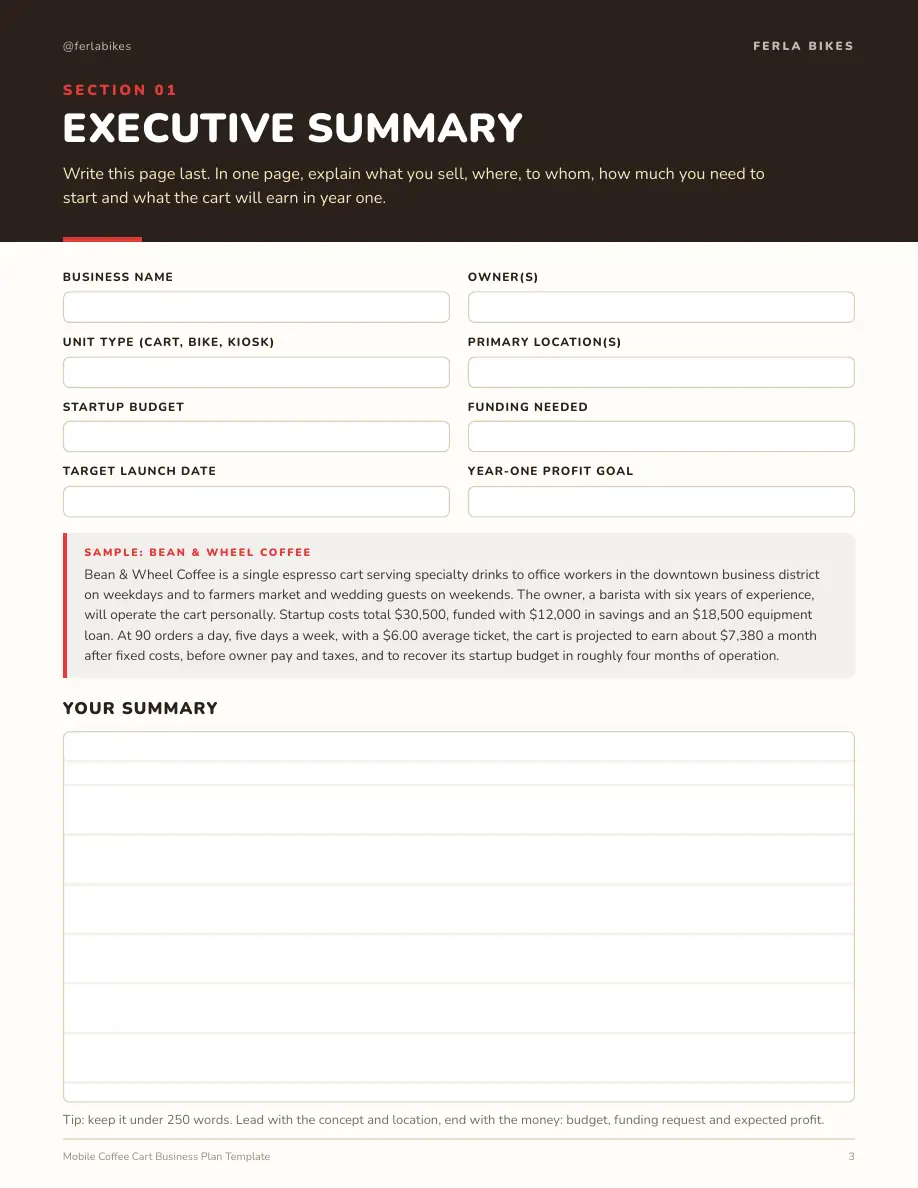
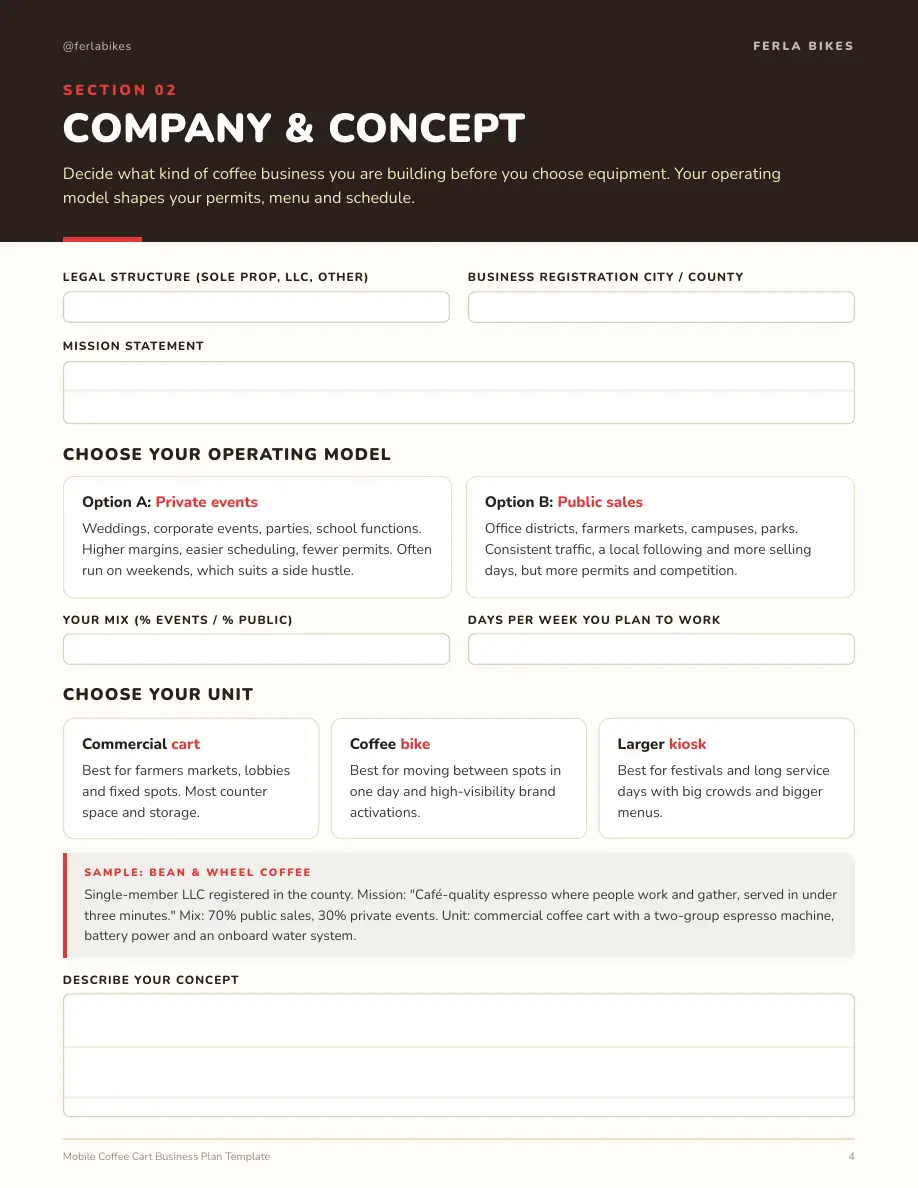
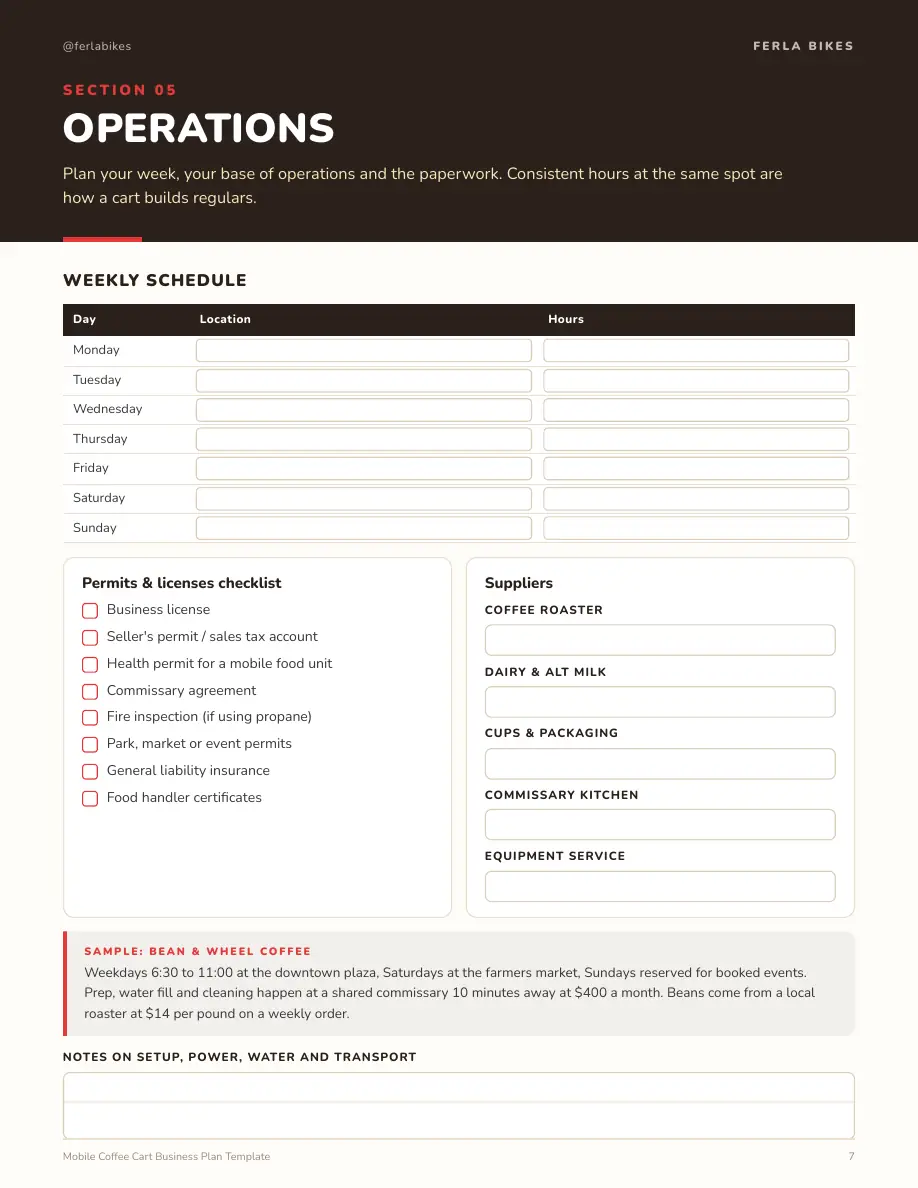
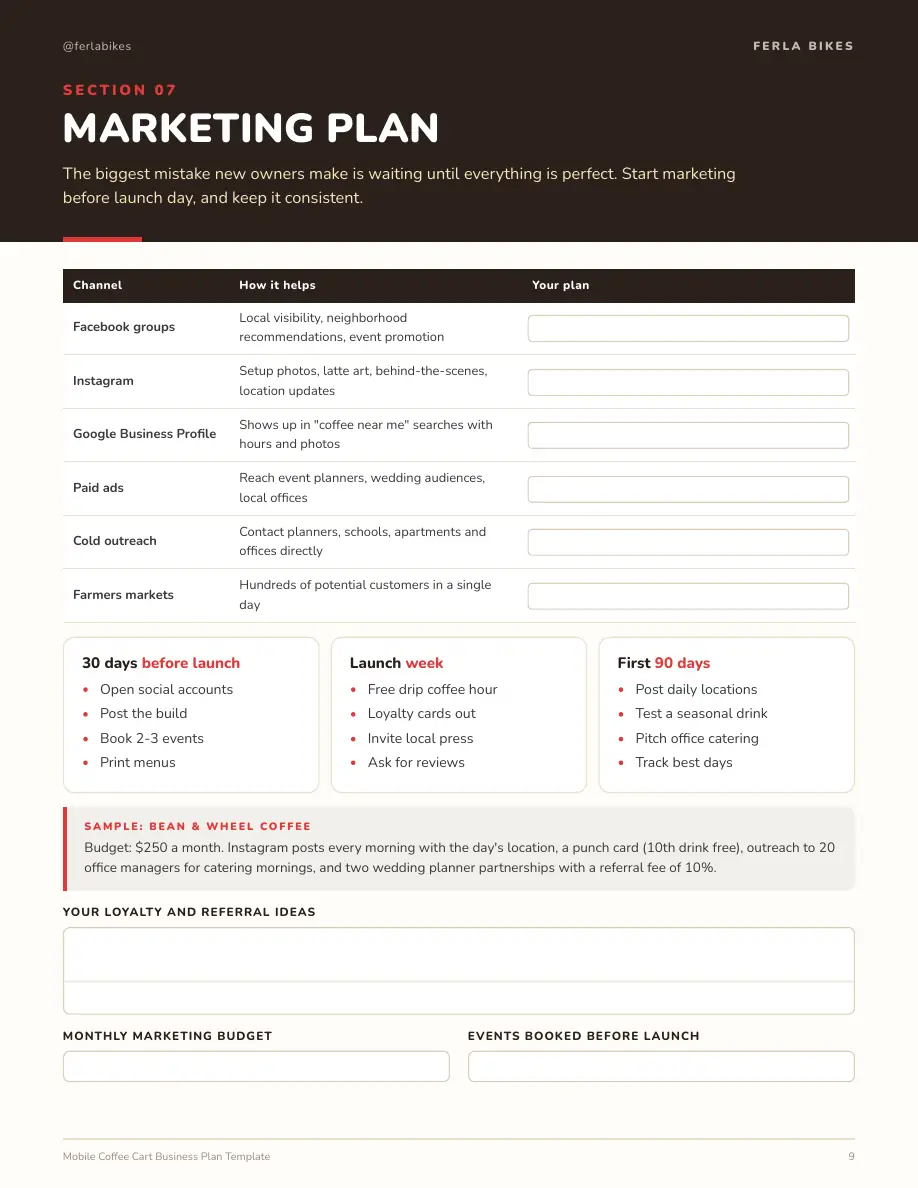
We built the file around the decisions new owners actually face. Each section opens with a short explanation, shows a finished answer for a fictional cart called Bean & Wheel Coffee, and leaves space for your figures. Type into the fillable fields on screen or print the pages and work with a pen. Because the sample sections connect, the business plan for coffee cart pdf behaves like a small model: menu prices feed margins, margins feed projections, and projections feed the break-even estimate.
How to Fill In Each Section
Executive summary and concept
Write the summary last, even though it sits on the first page. Keep it to one page that covers the concept, location strategy, startup budget and profit goal for year one. In the concept section, choose a fixed cart, a coffee bike or a larger kiosk. A business plan for a coffee cart that skips this choice usually overestimates sales. Then decide whether you will focus on private events, public sales or both. Private events bring higher margins and easier scheduling, while public spots build regulars.
Market, locations and competitors
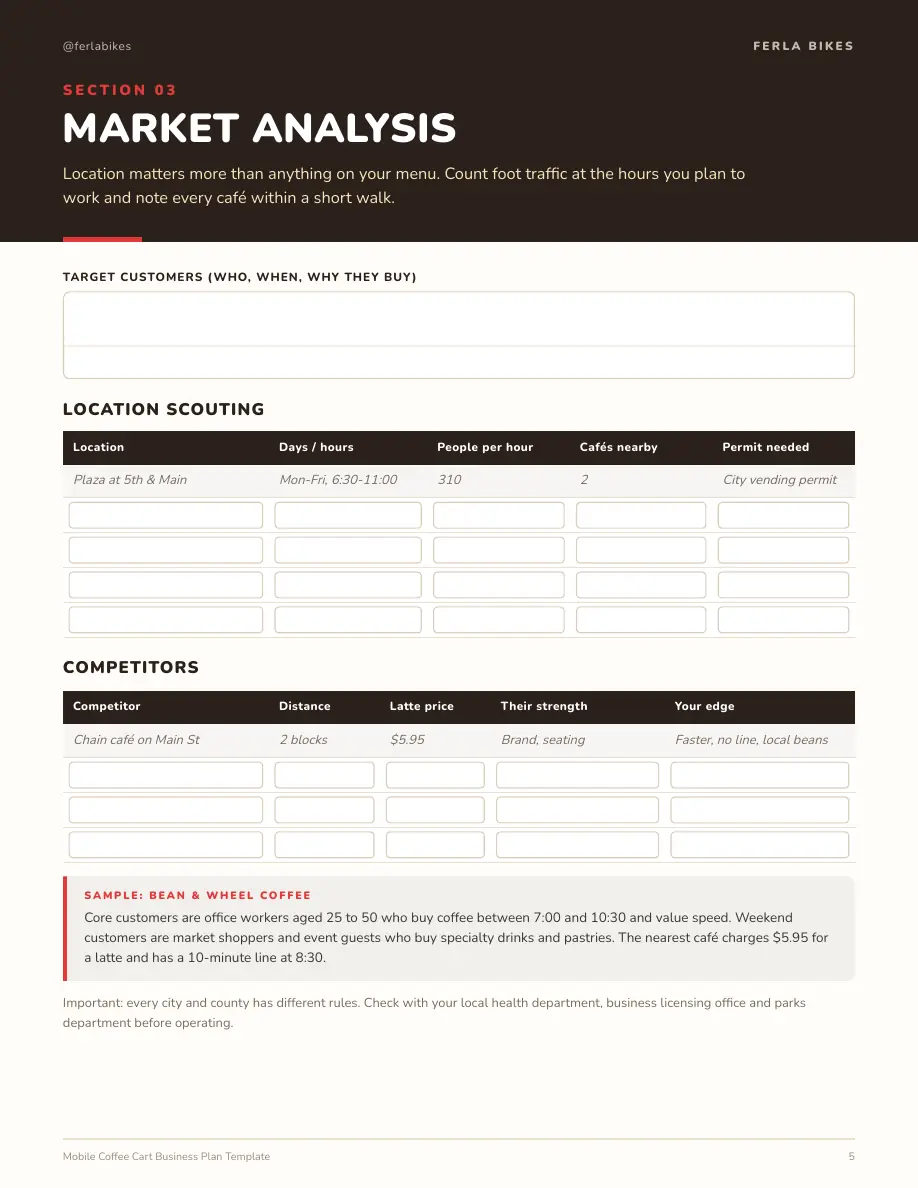
List three to five candidate spots and count foot traffic at the hours you plan to work. Office districts, campuses, hospitals, gyms and weekend markets all behave differently and peak at different hours, so note every café within a short walk and what it charges for a latte. Good mobile coffee cart plans rely on two kinds of locations: one steady weekday spot that pays the bills, plus a calendar of events that lifts the monthly total during busy seasons.
Menu, pricing and margins
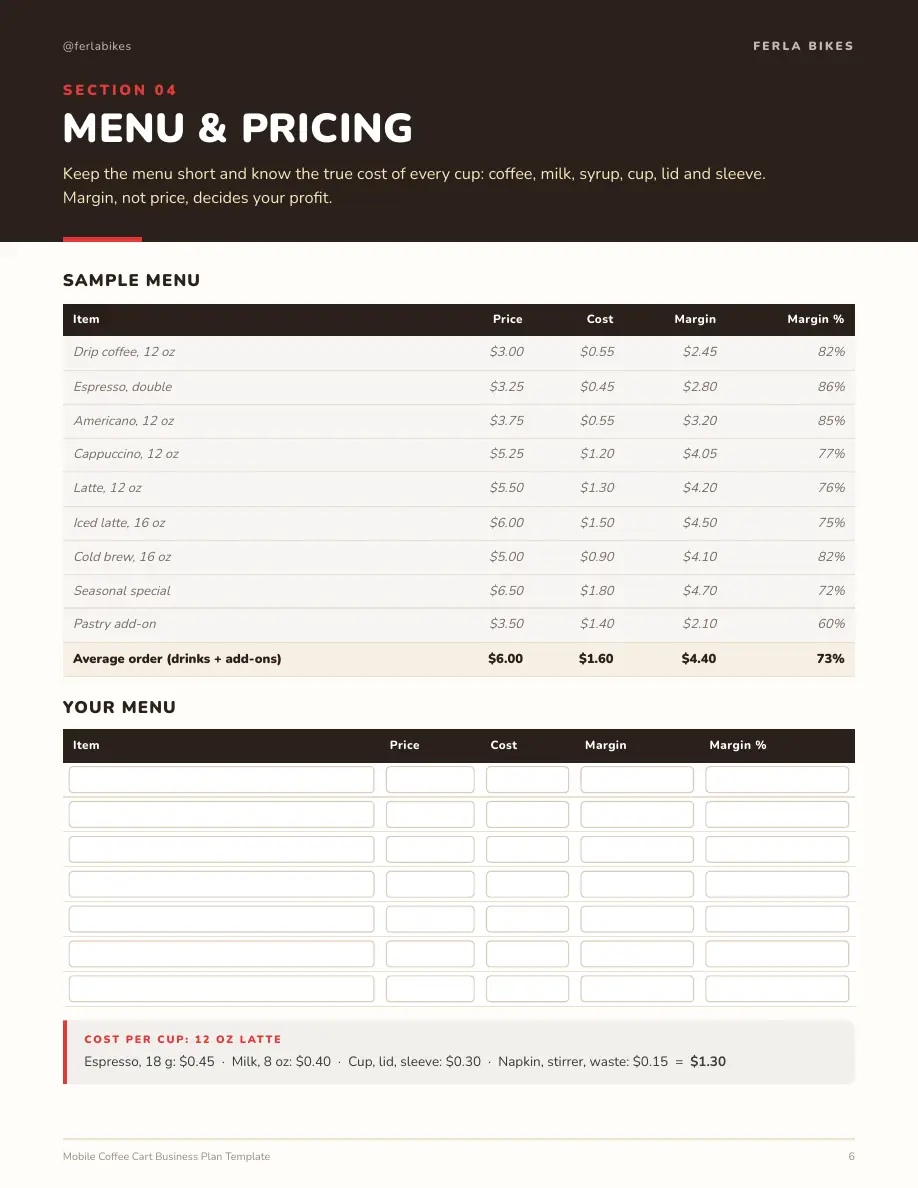
Keep the menu short. Six to ten drinks, one or two seasonal specials and a pastry add-on are enough for most carts. For every item, record the price and the full cost of the cup: coffee, milk, syrup, cup, lid and sleeve. Espresso drinks carry the margin, while drip coffee keeps lines moving during the rush. In the coffee cart business plan sample, a 12 oz latte sells for $5.50 and costs about $1.30 to make, which leaves a margin of 76 percent.
Startup and monthly costs
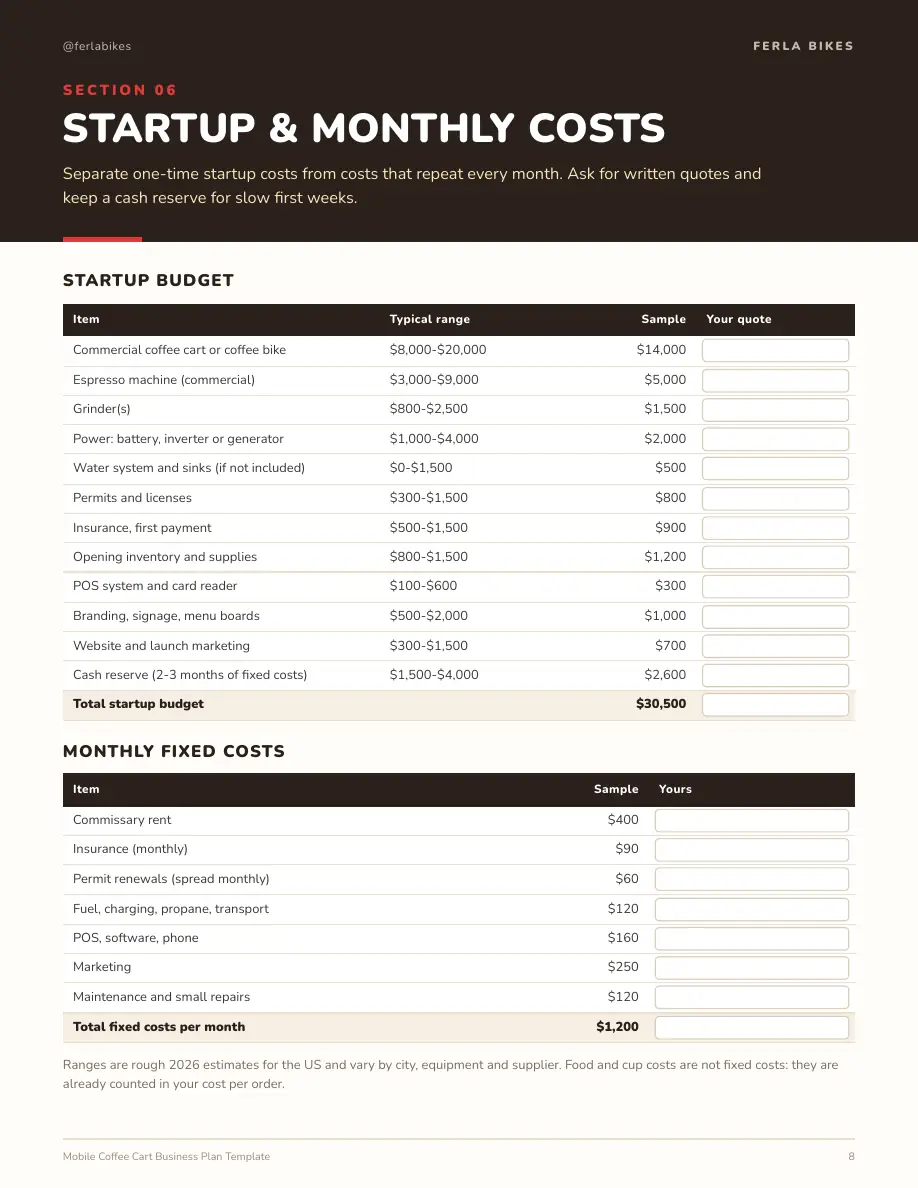
Separate one-time startup costs from costs that repeat every month. The cart, espresso machine, grinder, power system, permits, first insurance payment, opening inventory, POS and branding are startup costs. Commissary rent, insurance, fuel, software, marketing and maintenance are fixed monthly costs. The sample budget totals about $30,500, including a cash reserve for slow first weeks. Ask for written quotes for each line, since plans for coffee cart equipment vary widely by water system, power source and local health code.
Financial projections and break-even
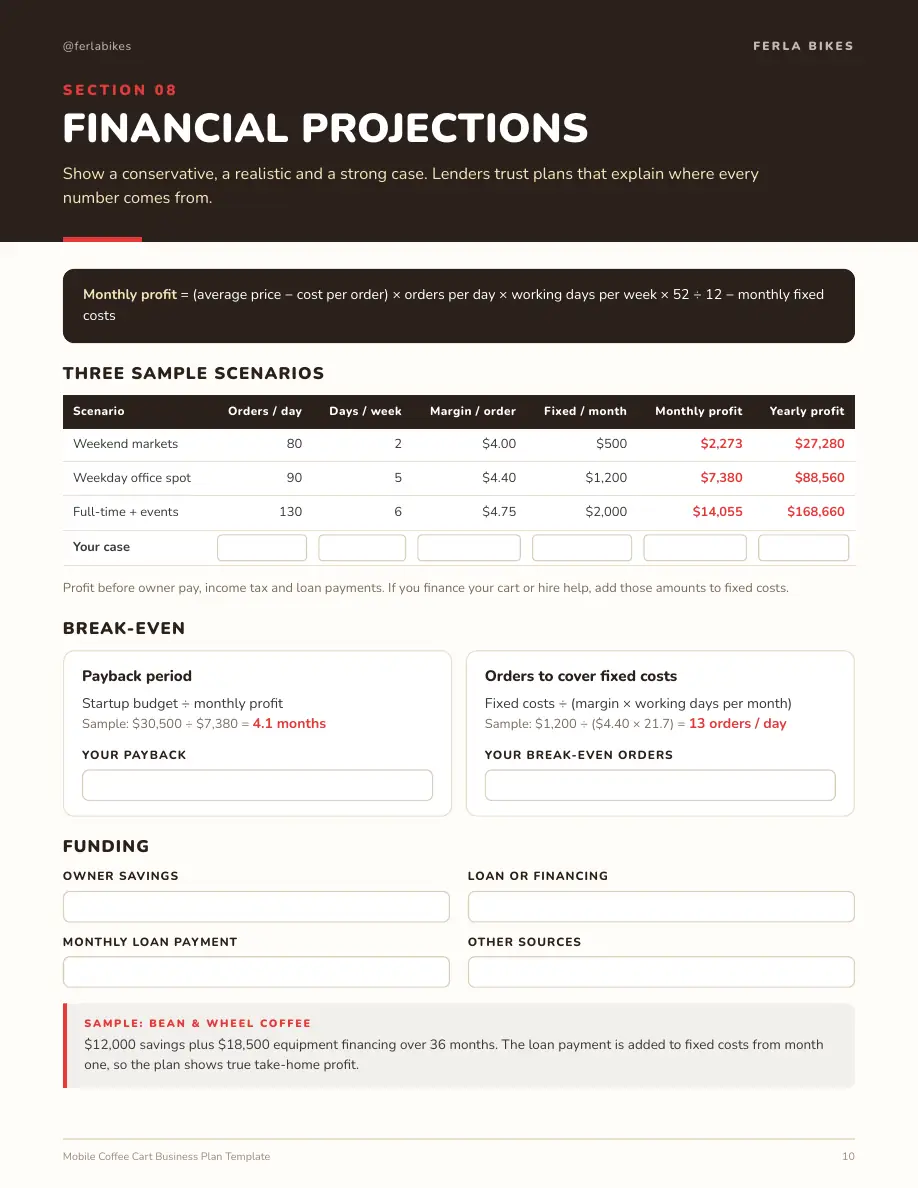
The projection page uses one formula: margin per order, times orders per day, times working days, converted to a month, minus fixed costs. The sample operator serves 90 orders a day, five days a week, at a $4.40 margin. That gives about $8,580 in monthly gross profit and roughly $7,380 after $1,200 in fixed costs, before owner pay and taxes. At that pace the budget pays back in about four months. Treat this coffee cart business plan example as a starting point, not a promise.
Sample Scenarios at a Glance
| Scenario | Orders per day | Days per week | Margin per order | Fixed costs / mo | Monthly profit |
|---|---|---|---|---|---|
| Weekend markets | 80 | 2 | $4.00 | $500 | $2,273 |
| Weekday office spot | 90 | 5 | $4.40 | $1,200 | $7,380 |
| Full-time spot + events | 130 | 6 | $4.75 | $2,000 | $14,055 |
Showing three outcomes makes the plan more credible. A conservative case protects you from optimism, and a strong case shows what the cart can do once regulars and bookings build up. Every example of a coffee cart business plan you show a lender should explain where the inputs come from, then base your personal budget on the middle row until real sales data arrives.
Mistakes That Weaken a Plan
- Borrowed numbers: national averages instead of prices from your own city.
- No commissary line: many health departments require one.
- Ignoring power: espresso machines need a reliable battery, generator or shore power.
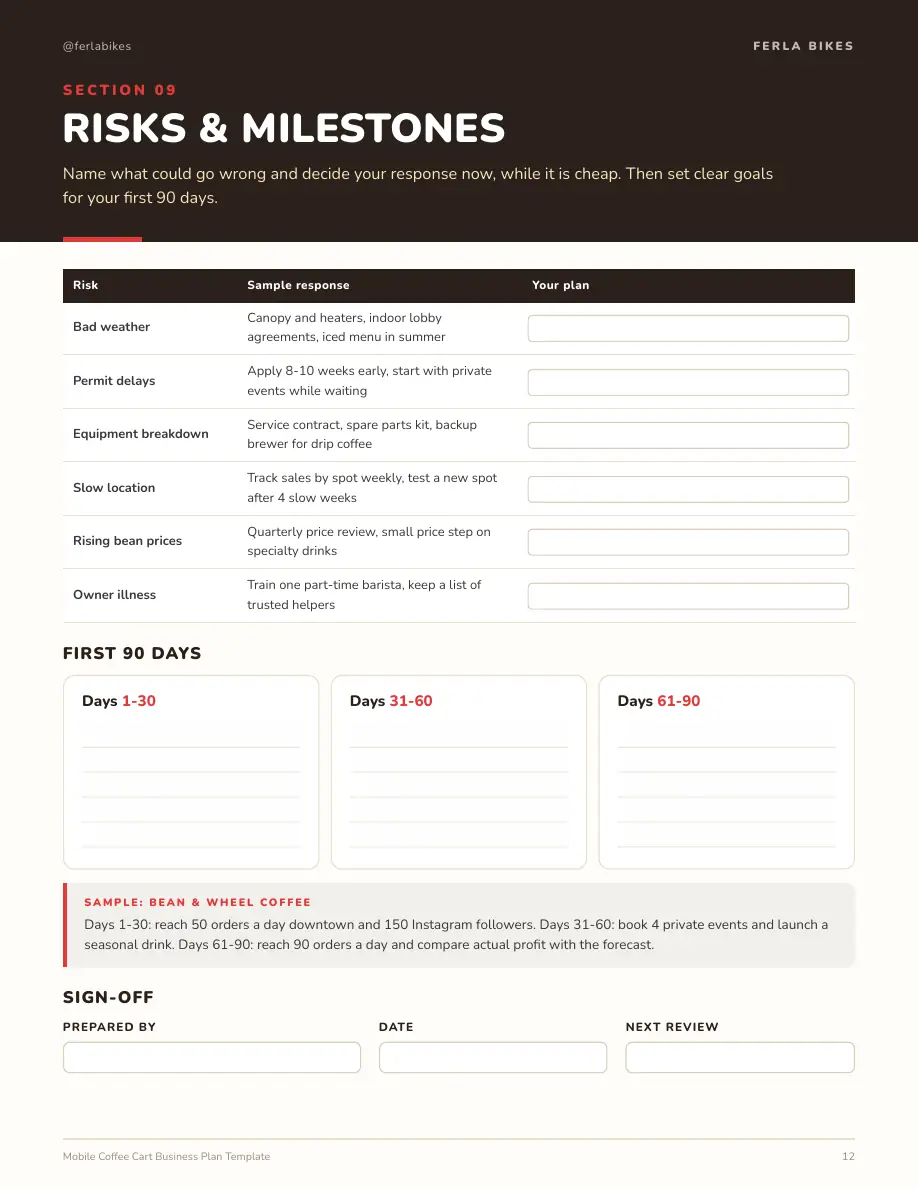
- No cash reserve: weather and slow weeks happen to every new cart.
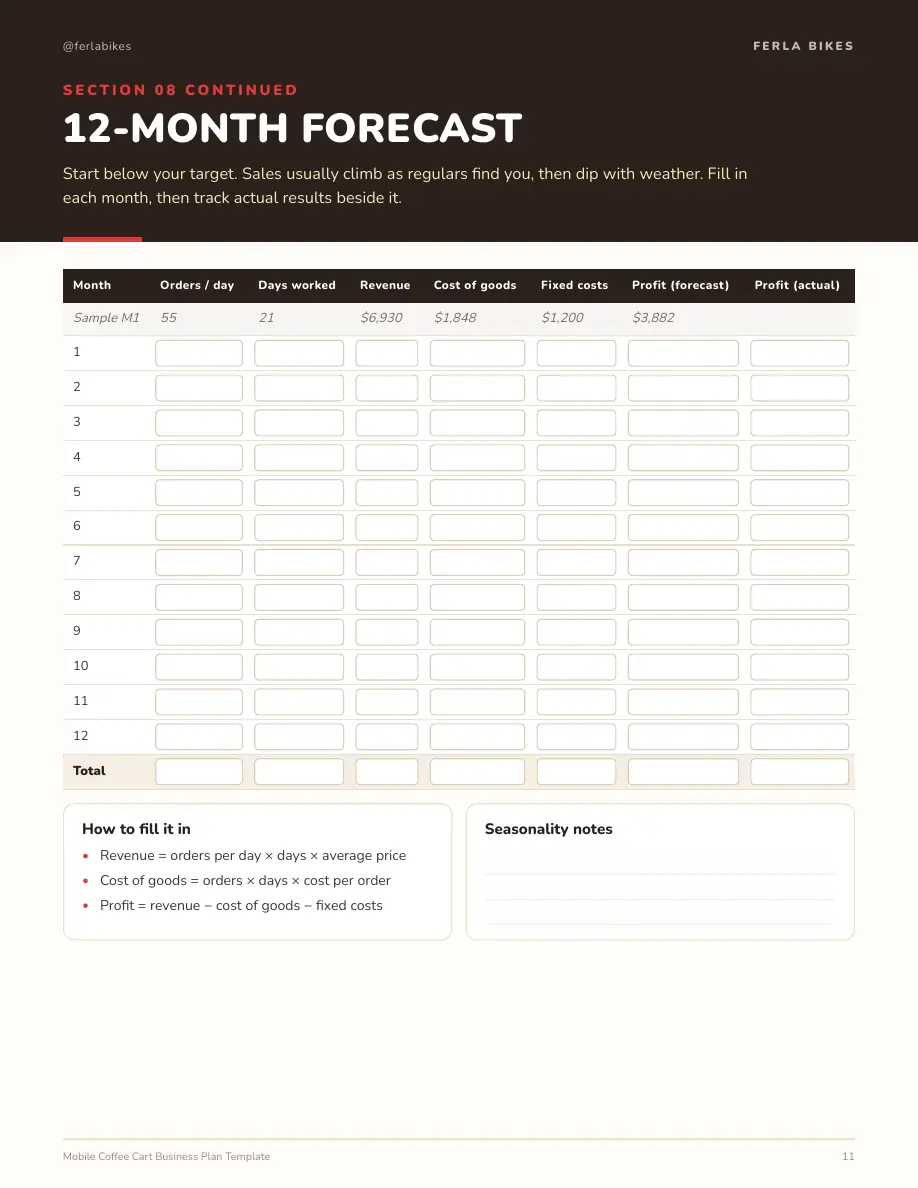
The business plan coffee cart owners actually use is the one they update. Review it monthly, compare real sales with the forecast page, and adjust prices, hours or locations instead of waiting for business to improve on its own.
Match the Equipment to the Plan
Your equipment decides your menu, speed and reach. A compact cart fits tight sidewalks and office lobbies. A pedal or electric coffee bike moves between spots during the day and works as a rolling billboard. Larger units with more storage handle event crowds without constant restocking. Before you finalize coffee cart plans, compare layouts on our coffee carts page. Ferla builds each format in Gardena, California, and you can configure the espresso setup, storage and branding in 3D.
If the cart is your largest expense, look at financing options so monthly payments come out of cart income from the first month, and ask your accountant whether the equipment qualifies for tax deductions. Add both numbers to the template before you sign any contract.
Frequently Asked Questions
How long should a business plan for coffee cart be?
Ten to fifteen pages is enough for most lenders and event organizers. Clarity matters more than length: a one-page summary, a costed menu, a startup budget and realistic projections. If a section does not help someone decide whether to lend, book or partner with you, cut it entirely.
Do I need a plan for a weekend side hustle?
Yes, even a short one. A weekend operator still pays for permits, insurance and inventory. A one-page business cart coffee plan with startup costs, prices and a break-even number keeps a side project from quietly losing money.
Is the template free to use?
Yes. Download the PDF, fill it in and share it with lenders, partners or event organizers. No sign-up is required. The sample business and its numbers are fictional, so replace them with your own before you submit the plan anywhere.
Can I use the template for other carts?
Yes. The structure works for most plans for mobile coffee food carts, ice cream bikes and snack carts. Change the menu table, adjust cost per order and the remaining sections still apply.
Ready to Build Your Cart?
Fill in the template, then talk to our team about a cart built for your menu and your city.
Get A Quote