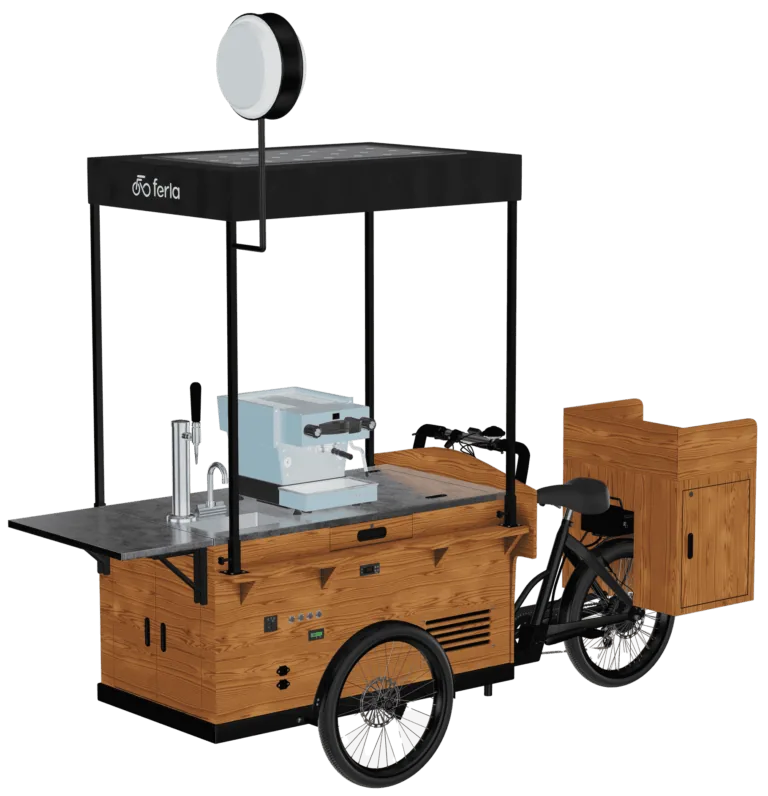
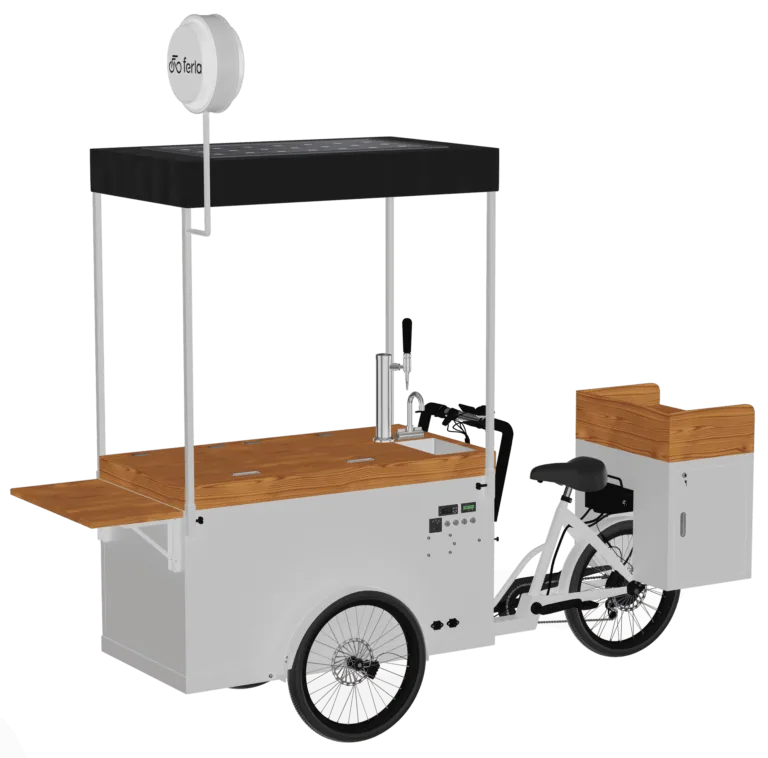
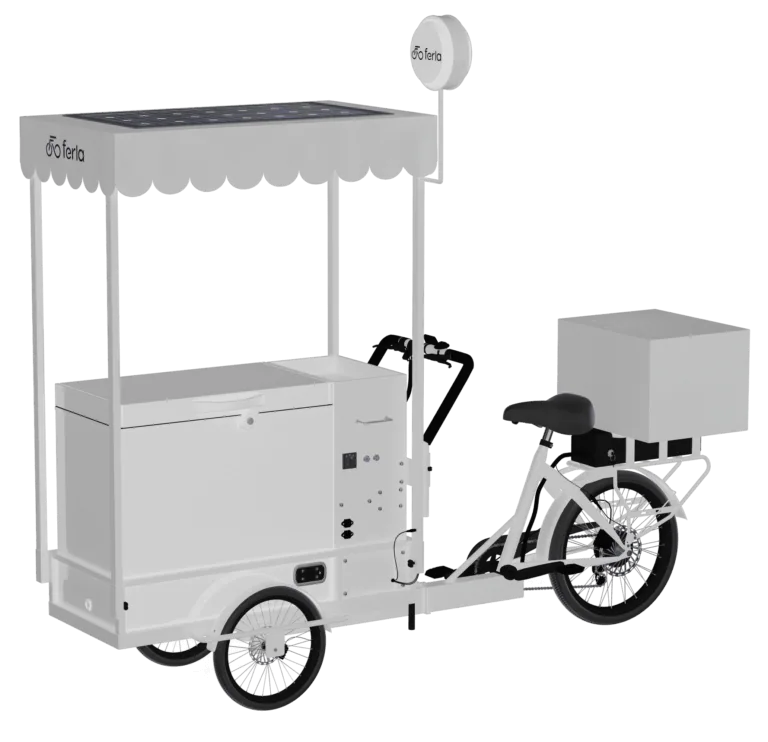
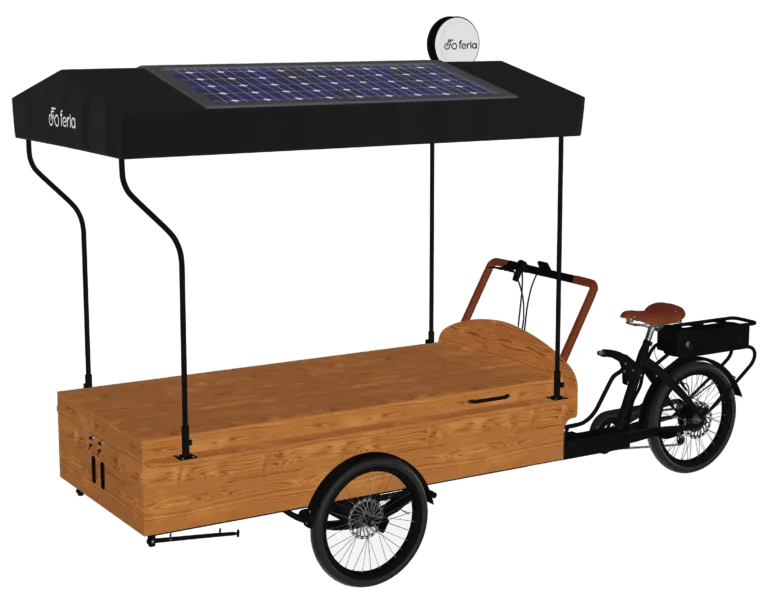
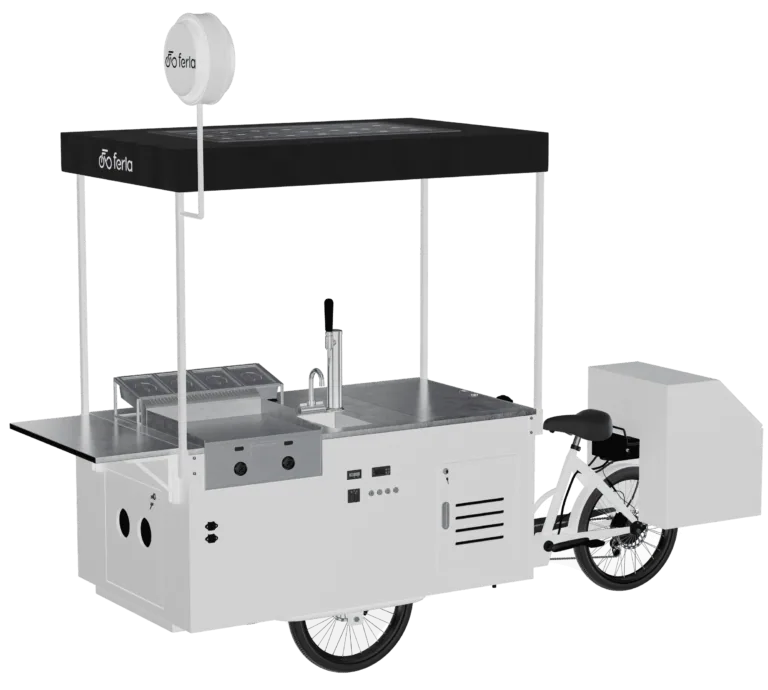
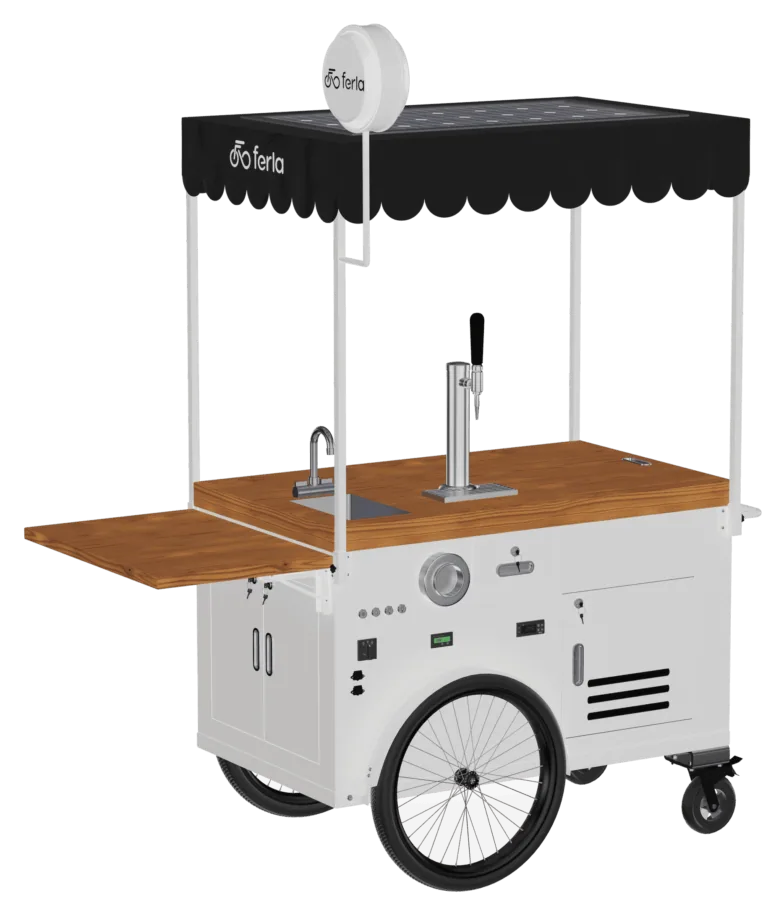
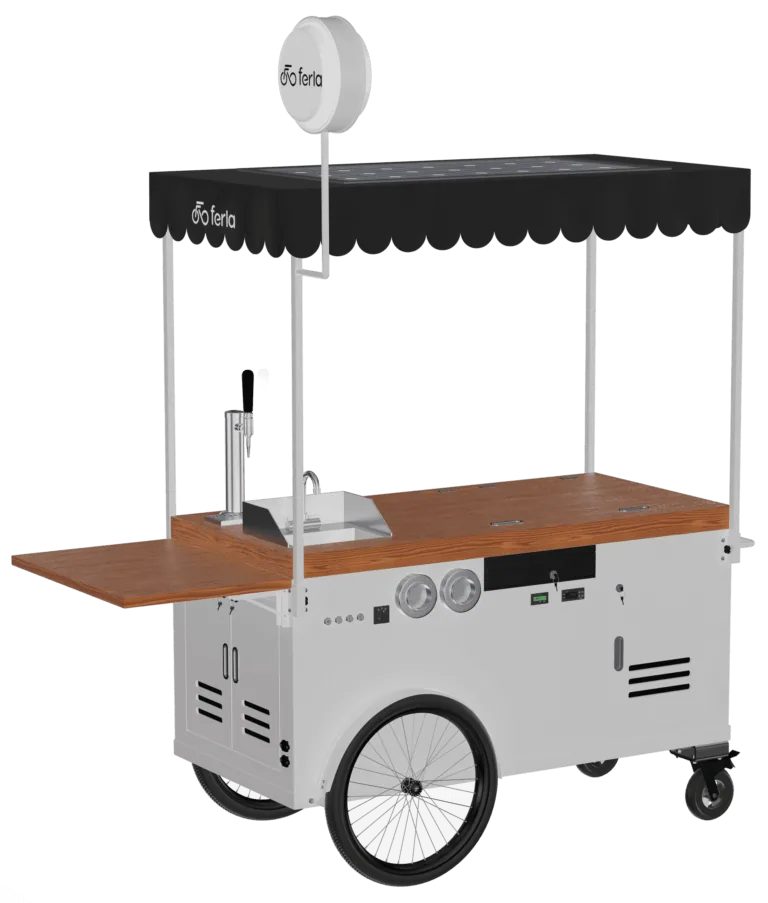
A coffee business no longer starts with a lease, a contractor, and six months of buildout. It starts with a unit you can roll into position, plug in, and open. Coffee kiosks let you put a full espresso setup exactly where your customers already are, office plazas, campuses, beachfronts, farmers markets, weddings, festivals, corporate activations, without paying retail rent for the privilege. Ferla builds mobile vending units designed around that model: premium materials, practical layouts, and enough space for a real coffee station in a footprint that fits through a standard doorway.
The economics are hard to argue with. A brick-and-mortar café ties up capital in construction and locks you into one address for years. If the foot traffic shifts, you’re stuck with it.
A coffee kiosk business inverts that. Your overhead is the unit, your inventory, and a space agreement you can renegotiate or walk away from. Your location isn’t a permanent bet, it’s a decision you make each morning. Serve the commuter rush outside an office tower, move to a park in the afternoon, book a wedding on Saturday. One asset, three revenue streams.
It’s also the fastest way into specialty coffee. Instead of waiting on permits for a shell space, you take delivery of a finished unit and work through licensing on a much shorter timeline.
Every Ferla unit is built to move, but there’s a meaningful difference between models.
Coffee bikes and trikes put the vending body on an electric-assist cycle. You ride to the pitch, park, and serve. Ideal for beach paths, park circuits, campuses, and any city where parking a vehicle is harder than parking a bike. They also draw a crowd on their own, a coffee trike is a marketing asset before it pours a single shot.
Push carts separate the vending body from the bike. A portable coffee kiosk in this format can be positioned by hand, towed into place, or wheeled into a lobby for an indoor event and back out again. Best when your locations are close together or the unit stays put through the day.
Mini carts are the compact option, smaller footprint, lower entry cost, same build quality. Popular with brands running promotions and with operators who need a small coffee kiosk that fits a tight venue allocation.
Because most trading happens outside, weather resistance is built in rather than bolted on. An outdoor coffee kiosk needs sealed surfaces, a canopy or umbrella mount, corrosion-resistant hardware, and materials that hold up to sun, salt air, and daily washdowns. Anything less looks tired within a season.
The cabinet is the platform. What determines your service speed is the equipment you fit inside it.
Ferla carts are designed to accept professional gear: espresso machine, grinder, water system, and refrigeration. Most operators run a one- or two-group machine with a dedicated espresso grinder, an under-counter or built-in fridge for milk, an ice well for cold drinks, and a fresh-water tank with grey-water collection so the unit works where no plumbing exists.
Your choice of coffee kiosk machine sets everything downstream. Superautomatics simplify staffing and keep service fast, which matters when you’re one person facing a queue. Traditional semi-automatic machines give you control over extraction and a better ceiling on quality, but demand a trained barista. Power draw follows the same logic, check your battery or shore-power capacity against the machine before committing.
Layout matters as much as equipment. Keep the grinder next to the machine, milk within arm’s reach of the steam wand, and the handoff point away from the ordering point. A well-planned bar shaves seconds off every drink, and seconds compound across a morning rush.
A cart is signage that generates revenue. Full-wrap decals, painted panels, LED display signs, menu boards, and custom colorways turn the unit into the most visible thing your business owns. Operators running promotions often care about this more than about drink throughput, the cart photographs well, holds attention, and gives customers something to remember.
If you’re extending an existing café brand, matching the cart to your storefront identity makes the mobile arm read as the same business rather than a side project.
Coffee kiosk cost depends on the body, the equipment package, and how much customization you add. Ferla’s Mini Cart starts at $4,499, or $199 per month with financing, which puts a professionally built vending unit well below the price of most used food trailers. Coffee bikes and larger carts move up from there depending on configuration, battery specification, refrigeration, and branding work.
Beyond the unit, plan for permits and health department review, initial inventory, insurance, and POS hardware. Requirements vary by city, so check with your local health authority before you order, it can influence which water and refrigeration options you need.
Financing is available across the range, and used units come up periodically at lower entry points. Payment terms as low as $99 per month have made coffee bikes accessible to operators who couldn’t fund a build outright.
Coffee kiosk manufacturers vary enormously in what actually arrives at your address. Ferla units are built from premium materials with commercial use in mind, ship across the United States, and come with customization handled in-house rather than farmed out. Financing options are available at checkout, and the sales team will walk through configuration before you commit, power, water, refrigeration, and layout, matched to where you actually plan to trade.
If you want to talk it through first, call +1 (213) 291-9070 and describe your location, your target drink volume, and your budget. It’s a five-minute conversation that prevents an expensive mismatch.
Explore the full lineup of coffee kiosks for sale below. Each product page lists dimensions, weight, included features, available options, and financing terms, so you can compare configurations side by side and pick the unit that fits your venue, your menu, and your permit.
Loved by everyone from entrepreneurs to large corporations
Custom-wrapped. Field-deployed.
A vending cart built to match the brand—refined, precise, and impossible to ignore.
Café Refuge is building a brand before the doors even open. With a Ferla Mini built to match their manual espresso setup, they’re making every impression count—clean lines, bold wheels, no compromises.
Huge thanks to Ferla for the stunning custom cart. It’s sleek, functional, and perfect for our espresso martini setup at the Zedd concert. Built-in fridge, full bar setup—exactly what we needed for a premium backstage experience. You nailed it, Ferla. We couldn’t be happier with how it turned out.
The Ferla Grande Cart has been perfect for my farmers market setup! It’s got tons of space for displaying produce, and the working surface is huge, making it easy to prep items on the spot. The cart is sturdy but easy to move, and it really stands out—people are always drawn to it. I also love that it has a canopy for those sunny days. It’s made my whole market experience smoother and more professional.
I’ve been using the Ferla Grande Cart for a few months now, and I’m seriously impressed. It’s well-built, easy to move around, and looks amazing. I use it to sell baked goods and jams at local markets, and customers are always complimenting the cart’s design. It’s been reliable, and it helps me stay organized while adding a professional touch to my business. I’m really happy with this purchase!
The Ferla Grande Cart has completely transformed how I run my catering business. I use it for outdoor events and weddings, and the response has been incredible. The cart’s design is sleek and professional, which really elevates the presentation of the food. It’s easy to customize for different themes, and I love that I can move it effortlessly between venues. Guests are always drawn to it, and it creates a fun, interactive experience. It’s not just a cart; it’s a centerpiece for my business, and it’s helped me stand out from the competition.
I spent weeks researching different carts for my mobile food business, and Ferla easily came out on top. The quality, design, and functionality are miles ahead of the competition. Other carts I looked at either lacked storage, felt flimsy, or didn’t have the customization options I needed. The Ferla Grande Cart not only has the perfect setup for my needs, but the attention to detail—like the sink and durable materials—just shows how well-made it is. I’m so glad I chose Ferla. It’s worth every penny.
As a professional event bartender, the Ferla Mini Cart has been a game-changer for me. Its sleek design adds a touch of class to any venue, and the mobility allows me to easily navigate through crowded spaces. The temperature-controlled freezer is perfect for keeping beverages chilled, and the large storage means I can carry all my mixers and tools without hassle. Clients love the aesthetic, and it’s elevated the overall experience at the events I serve.
We recently incorporated the Ferla Mini Cart into our hotel’s reception area, and it’s been a fantastic addition. We use it to offer guests complimentary coffee and pastries in the morning and switch to wine and appetizers in the evening. The cart’s elegant design fits perfectly with our hotel’s ambiance. The hidden storage keeps everything tidy, and the mobility allows us to reposition it for different events. Guests frequently compliment us on this unique touch.
Entry is usually $6,000–$20,000 all in, depending on the unit and equipment. The cart itself starts at $4,499; the rest goes to your espresso setup, permits, inventory, insurance, and a small operating cushion. Financing spreads the largest piece across monthly payments.
Yes. Most cities require a mobile food facility permit, a food handler certification, and a plan review before you open. Some also require a commissary agreement. Rules differ by county, so confirm locally before ordering.
Yes, through most of the day. Add a second person once your morning rush consistently exceeds roughly 80–100 drinks, or your line will start walking away.
Battery systems power the electric-assist drive and onboard equipment, while fresh-water tanks and grey-water collection let you operate where there’s no plumbing. High-draw espresso machines may need shore power depending on your volume, discuss it during configuration.
Yes. Wraps, painted panels, LED signs, menu boards, and custom color schemes are all available, and can be matched to an existing brand identity.
Yes, units ship throughout the United States. Delivery timelines depend on configuration and current production schedule.
Optional: a few details help us send the right quote.